



Forex is the global market for buying and selling currencies, and it is the largest financial market in the world — more than $7.5 trillion changes hands every day. “Forex” is short for foreign exchange, and every trade is simply one currency exchanged for another. This guide explains what forex is, how it works, and how a beginner can start trading it.
What is forex?
Forex (foreign exchange) is the marketplace where the world’s currencies are traded. Every time a bank, business, or traveler converts one currency into another, that is a forex transaction. Traders take part to profit from the constant shifts in exchange rates.
Forex stands apart from other markets in three ways:
- It is the biggest and most liquid — over $7.5 trillion in daily volume, so you can enter and exit trades almost instantly.
- It runs 24 hours a day, 5 days a week, following the sun across the Sydney, Tokyo, London, and New York sessions.
- It is decentralized — there is no single exchange; currencies trade directly between participants worldwide.
How forex trading works
Currencies are always traded in pairs, because you are buying one while selling another. A quote like EUR/USD = 1.1000 tells you exactly how the pair is priced.

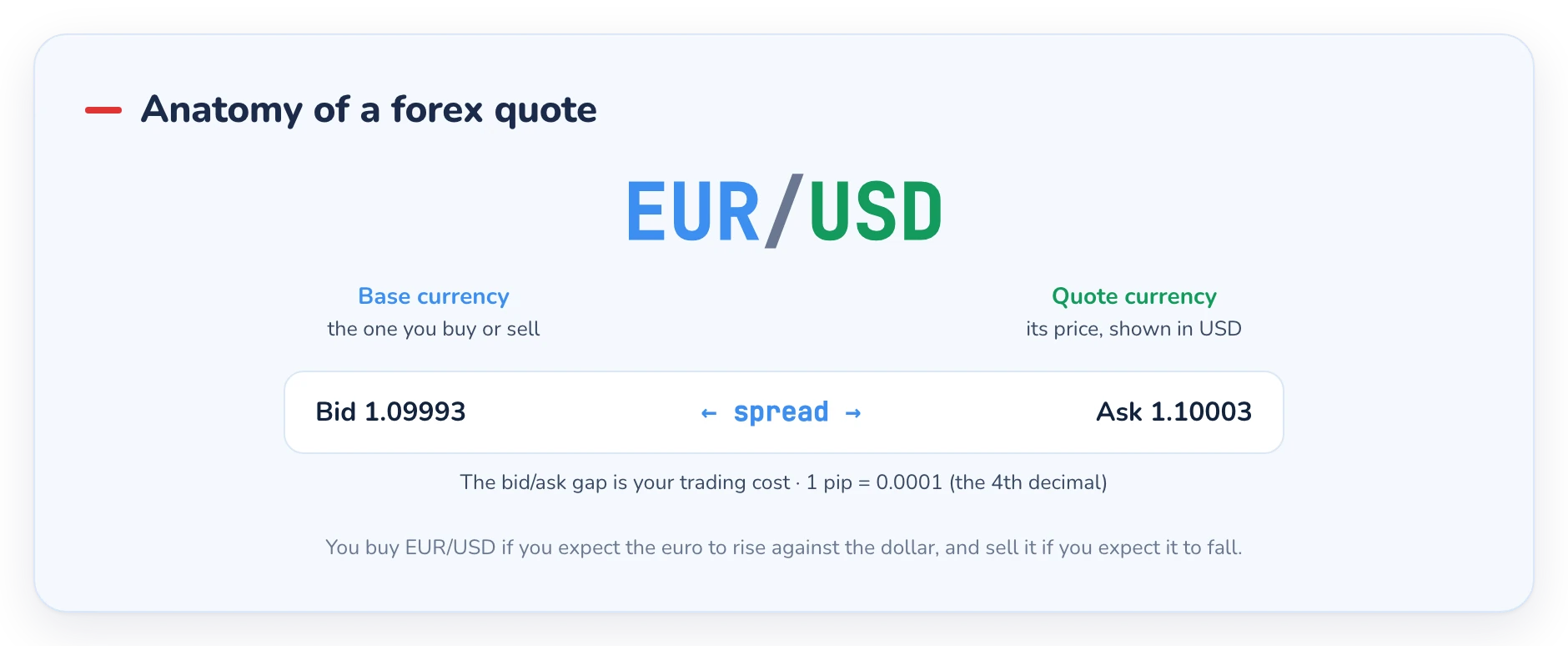
- Base currency — the first one (EUR). It is what you are buying or selling.
- Quote currency — the second (USD). It shows how much of it one unit of the base is worth.
- Bid and ask — the sell and buy prices; the small gap between them is the spread, your main trading cost.
- Pip — the smallest standard price move, usually the fourth decimal (0.0001). If EUR/USD moves from 1.1000 to 1.1001, that is one pip.
- Lot — the trade size. A standard lot is 100,000 units, a mini lot 10,000, and a micro lot 1,000.
If you expect the euro to strengthen against the dollar, you buy EUR/USD; if you expect it to weaken, you sell. Your profit or loss is the number of pips the price moves, multiplied by your position size.
The major currency pairs
A handful of pairs dominate trading volume. The “majors” all involve the US dollar and carry the tightest spreads:
| Pair | Nickname | Currencies |
|---|---|---|
| EUR/USD | “Fiber” | Euro / US dollar |
| GBP/USD | “Cable” | British pound / US dollar |
| USD/JPY | “Gopher” | US dollar / Japanese yen |
| USD/CHF | “Swissie” | US dollar / Swiss franc |
| AUD/USD | “Aussie” | Australian dollar / US dollar |
Beginners usually start with EUR/USD because it is the most liquid pair in the world, with tight spreads and plenty of educational material.
When can you trade forex?
The market is open 24 hours from Sunday evening to Friday evening, split into four sessions. Volume and volatility peak during the London–New York overlap (roughly 8am to 12pm ET), when two of the largest sessions run at once. Major pairs are most active then, which is why many traders focus their day around that window.
Leverage and risk
Forex is usually traded with leverage, which lets a small deposit control a larger position. At 1:30 leverage, a $1,000 margin controls a $30,000 position. That magnifies gains — and losses — equally, so a small move against you can cost far more than it first appears. Leverage is the same double-edged tool used in CFD trading, and it makes disciplined risk management essential.
Be clear-eyed: forex is high-risk and leveraged. You can lose money quickly, including more than you expect. Only trade money you can afford to lose, and always use a stop-loss.
Why do people trade forex?
- Accessibility — you can start small, and the market is open around the clock.
- Liquidity — deep volume means fast execution and tight spreads on major pairs.
- Two-way opportunity — you can profit from a currency rising or falling.
- Low barriers — a laptop, an internet connection, and a broker account are enough to begin.
The flip side is that the same features — leverage and constant access — make it easy to over-trade and lose money without a plan.
How to start trading forex with Tradeview Markets
- Open a demo account to practice with virtual funds and learn the platform.
- Trade the major pairs on the MetaTrader and cTrader platforms.
- Risk a small, fixed percentage per trade (many start at 1%) and always attach a stop-loss.
- When you are consistent, open a live account and start small. New to the mechanics? Our forex trading for beginners guide walks through your first trade step by step.
Frequently asked questions
Is forex trading profitable?
It can be, but nothing is guaranteed. Your results depend on your strategy, your risk control, and the market. Most beginners lose at first, which is why practicing on a demo and risking small amounts matters so much.
How much money do I need to start forex trading?
Less than most markets — many brokers let you open an account with a small deposit and trade micro lots. The key is to fund only what you can afford to lose.
Is forex trading legal?
Yes, forex trading is legal and widely available through regulated brokers. Always check your broker’s regulatory status and the rules in your country.
What is the best currency pair for beginners?
EUR/USD is the usual starting point. It is the most liquid pair, has the tightest spreads, and is the most widely documented, which makes it easier to learn on.
What is the difference between forex and stocks?
Forex trades currency pairs 24 hours a day with high leverage; stocks are shares of companies traded during exchange hours, usually with little or no leverage. Forex is faster and more liquid; stocks give you ownership.
Sources
- Bank for International Settlements (2025). Triennial Central Bank Survey — OTC foreign exchange turnover in April 2025. Global FX turnover reached $9.6 trillion per day. bis.org
- European Securities and Markets Authority (2018). ESMA agrees to prohibit binary options and restrict CFDs to protect retail investors — 74–89% of retail CFD accounts lose money. esma.europa.eu
Risk warning. Trading Forex and CFDs carries a high level of risk and may not be suitable for all investors. Leverage can work against you as well as for you. This article is for educational purposes only and does not constitute financial advice. Only trade money you can afford to lose.