



Scalping is the fastest trading style there is: dozens of tiny trades a day, each held for seconds to minutes, aiming for just a few pips at a time. It’s high-intensity, high-effort, and unforgiving of hesitation — which makes it one of the hardest styles for beginners. This guide covers how scalping works, what you need, and whether it’s right for you.
How scalping works
A scalper takes many small trades and closes them almost immediately, aiming to bank 5 to 10 pips (or a few cents on a stock) per trade. Do that 20 or 50 times a day and the small wins add up — in theory.

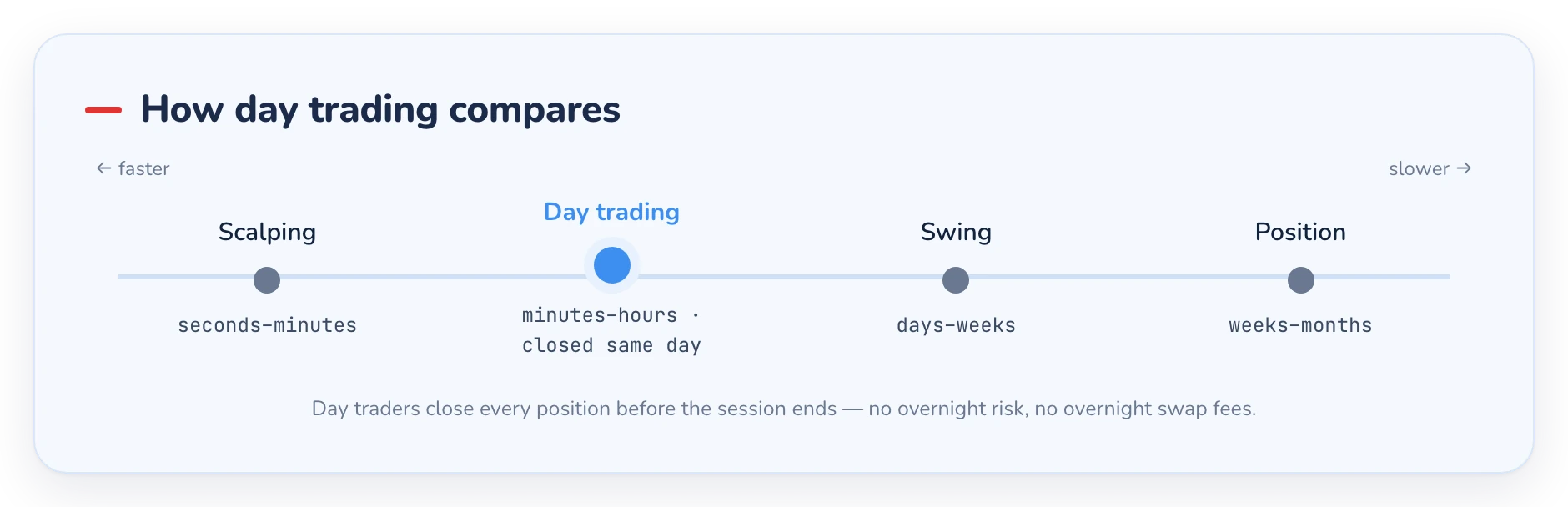
It sits at the extreme fast end of the spectrum: far quicker than day trading, where positions last minutes to hours. A scalper might be in and out of a trade before a day trader has finished reading the chart.
What you need to scalp
Scalping only works with the right conditions:
- Tight spreads. Since you target a few pips, a wide spread can eat your entire profit. Scalpers trade the most liquid pairs, like EUR/USD.
- Fast execution. Slippage of even a pip matters, so you need a platform that fills instantly.
- Total focus. You watch every tick — there’s no stepping away.
- A repeatable setup. A mechanical entry and exit you can execute in seconds, without second-guessing.
The pros and cons
Pros: many opportunities a day, no overnight risk (you close everything), and small individual losses if you’re disciplined.
Cons: trading costs pile up fast because you trade so often; it’s mentally exhausting; and a single moment of hesitation or a few missed stops can wipe out a day’s small gains. The math is brutal — your average win must clearly beat the spread plus your average loss.
Is scalping good for beginners?
Rarely. Scalping demands fast decisions, iron discipline, and tight costs — a lot to handle while you’re still learning the basics. Most beginners do better on slower timeframes like swing or trend trading, where there’s time to think. If scalping appeals, learn a slower style first, then practice scalping on a demo account before risking real money.
Be clear-eyed: scalping is high-risk and high-effort. Costs and slippage can turn small edges into losses. Only trade money you can afford to lose.
How to try scalping safely
- Practice on a demo account until your execution is automatic.
- Trade only the most liquid pairs with the tightest spreads.
- Keep strict risk limits and a daily loss cap.
- Build your method from a tested plan — see our beginner’s trading guide.
Frequently asked questions
Is scalping profitable?
It can be for experienced, disciplined traders with tight costs — but it’s one of the hardest styles, and trading costs make it unforgiving. Most beginners struggle with it.
How many trades do scalpers make a day?
Often dozens — anywhere from 10 to 100+ — since each targets only a few pips.
Is scalping allowed by all brokers?
Most allow it, but some restrict very-short-hold strategies. Always check your broker’s terms before scalping.
What timeframe do scalpers use?
Very short ones — typically the 1-minute to 5-minute charts.
Sources
- Chague, F., De-Losso, R., & Giovannetti, B. (2020). Day Trading for a Living? — of persistent retail day traders in Brazil, 97% lost money. papers.ssrn.com
- Barber, B. M., & Odean, T. (2000). Trading Is Hazardous to Your Wealth. The Journal of Finance, 55(2), 773–806 — the most active individual traders badly underperformed the market after costs. doi.org
Risk warning. Trading Forex and CFDs carries a high level of risk and may not be suitable for all investors. Scalping’s frequent trading amplifies costs. This article is for educational purposes only and does not constitute financial advice.