



The spread is the difference between the buy price and the sell price of a currency pair — and it’s the main cost of every forex trade. Every time you open a position, you start slightly in the red by the size of the spread. This short guide explains how the spread works, how it’s measured, and how to keep it as low as possible.
How the spread works
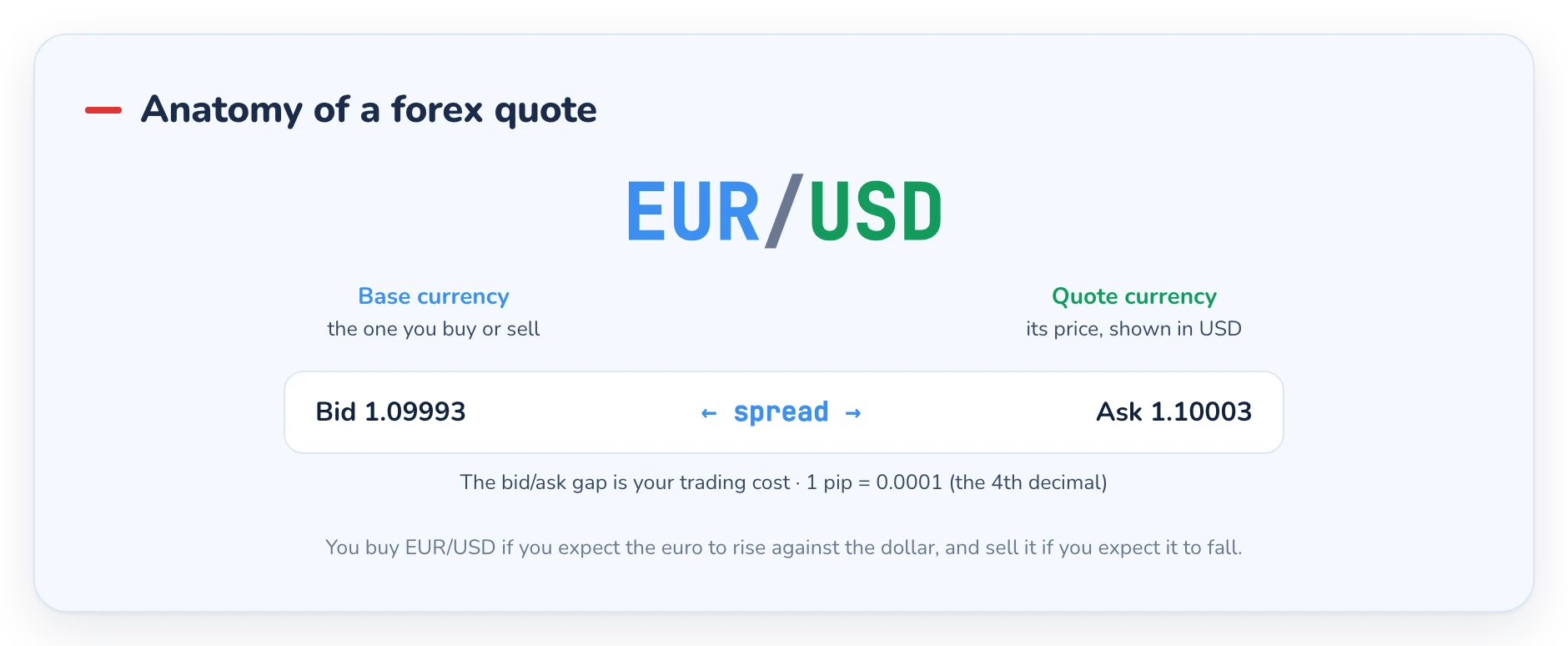
Every forex pair has two prices: the bid (what you can sell at) and the ask (what you can buy at). The gap between them is the spread.
Say EUR/USD shows a bid of 1.09993 and an ask of 1.10003. The spread is the difference — 0.0001, or 1 pip. Buy at the ask and the price must rise by at least the spread before you break even. That’s why the spread is a cost, not a fee: it’s built into the price.
How the spread is measured
Spreads are quoted in pips — the fourth decimal on most pairs. Common examples:

| Pair | Typical spread |
|---|---|
| EUR/USD | ~0.1–1 pip |
| GBP/USD | ~1–2 pips |
| USD/JPY | ~0.5–1 pip |
| Exotic pairs | 10+ pips |
The most liquid pairs (the majors) have the tightest spreads; thin, exotic pairs are far wider. See how pip values scale by pair and lot size on our Forex market page.
Fixed vs variable spreads
- Variable (floating) spreads move with the market — tight in calm, liquid conditions and wider during news or low-liquidity hours.
- Fixed spreads stay constant regardless of conditions, trading predictability for a usually slightly higher average cost.
Most brokers offer variable spreads, which are tightest during peak trading hours.
Why the spread matters
The spread is a cost you pay on every trade, so it adds up fast if you trade often. A scalper taking 20 trades a day pays the spread 20 times; a swing trader holding for weeks pays it once. The tighter the spread, the less the price has to move for you to profit.
How to keep the spread low
- Trade major pairs like EUR/USD, where spreads are tightest.
- Trade during peak hours — the London–New York overlap, when liquidity is highest.
- Avoid news spikes, when spreads can widen sharply for a few seconds.
- Compare brokers, since spreads and any commission vary. Check the current spreads on the trading platforms you use.
Related guides
Frequently asked questions
Is the spread the same as a commission?
Not quite. The spread is built into the buy/sell prices, while a commission is a separate charge some brokers add on top. Both are costs of trading.
What is a good spread in forex?
On EUR/USD, well under 1 pip is competitive. What counts as “good” depends on the pair — exotics are naturally much wider.
Why did my spread suddenly widen?
Usually low liquidity or a news release. Spreads widen when fewer participants are trading or when volatility spikes around economic data.
Do I pay the spread when I open or close?
You effectively pay it on entry — you buy at the ask and can only sell at the (lower) bid, so you start each trade down by the spread.
Sources
- Bank for International Settlements (2025). Triennial Central Bank Survey — OTC foreign exchange turnover in April 2025. Global FX turnover reached $9.6 trillion per day. bis.org
- Barber, B. M., & Odean, T. (2000). Trading Is Hazardous to Your Wealth: The Common Stock Investment Performance of Individual Investors. The Journal of Finance, 55(2), 773–806. doi.org
Risk warning. Trading Forex and CFDs carries a high level of risk and may not be suitable for all investors. Spreads vary by broker, pair, and market conditions. This article is for educational purposes only and does not constitute financial advice.