

Risk management is what keeps traders in the game. Most beginners lose not because they pick the wrong trades, but because one or two oversized losses wipe out many small wins. Get your risk rules right and you can be wrong often and still come out ahead. This guide covers the core rules: the 1% rule, stop-losses, reward-to-risk, and position sizing.
Why risk management matters more than being right
You don’t control whether a trade wins — you only control how much you lose when it doesn’t. A trader who risks 2% per trade can survive a 10-loss streak; one who risks 20% is wiped out by five. Protecting capital is the whole job, because you can’t trade tomorrow if you blow up today.
The core rules
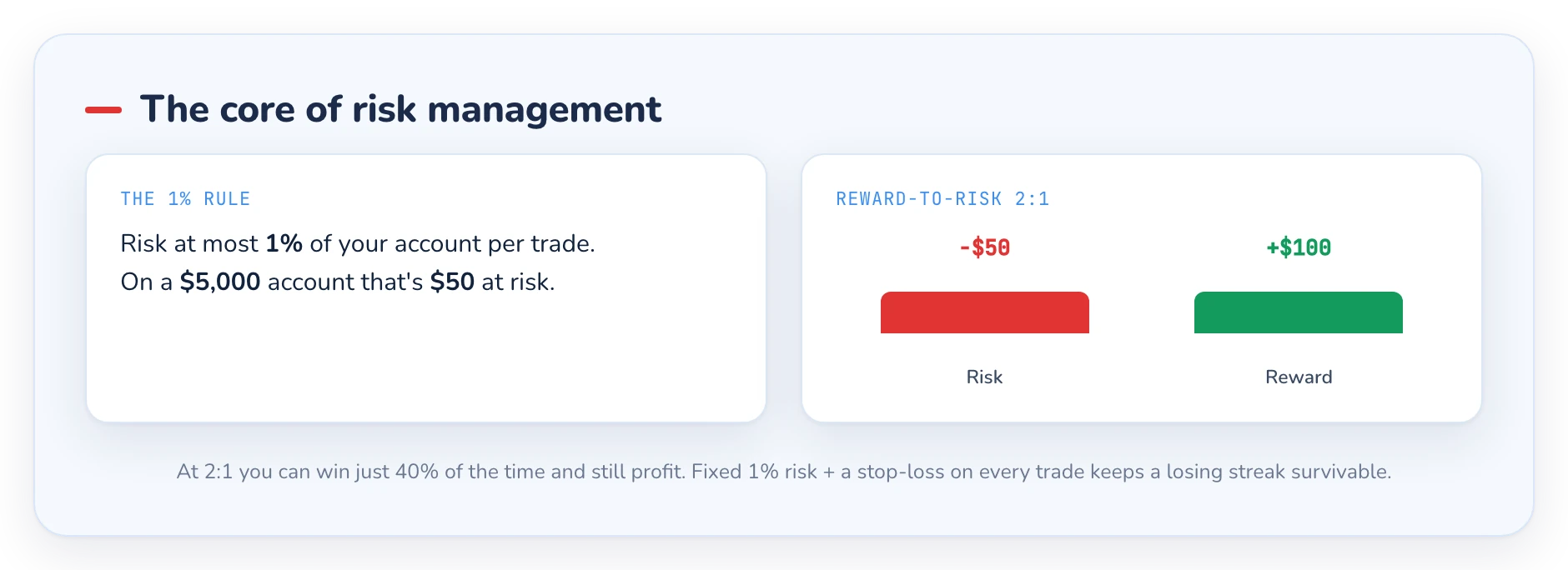
- The 1% rule. Risk no more than 1% of your account on any single trade. On a $5,000 account, that’s $50 at risk per trade — a losing streak stings but never ruins you.
- Always use a stop-loss. Decide your exit before you enter and let the order execute it. Hope is not an exit plan.
- Reward-to-risk ratio. Target at least 2:1 — risk $50 to make $100. At 2:1 you can win just 40% of the time and still profit.
- Cap your losses. Set a daily or weekly loss limit and walk away when you hit it.
How position sizing ties it together
Position sizing turns the 1% rule into an actual trade size. The formula:
Position size = account risk ÷ (stop distance × value per point)
Say you have $5,000, risk 1% ($50), and your stop is 20 pips away on a pair where each pip is worth about $1 per mini lot. $50 ÷ (20 × $1) = 2.5 mini lots. Change the stop distance and the size changes — but your dollar risk stays fixed at $50. That discipline is the engine behind every strategy.
Beyond the single trade
- Watch correlation. Two highly correlated positions (say EUR/USD and GBP/USD long) double your real risk — treat them as one bet.
- Mind leverage. High leverage makes it easy to over-size; keep a healthy margin buffer.
- Keep a journal. Reviewing your trades is how you catch rule-breaking before it costs you.
Be clear-eyed: no rule removes risk. You can still lose, including more than you deposit with leverage. Only trade money you can afford to lose.
Related guides
Frequently asked questions
What is the 1% rule in trading?
Risk no more than 1% of your account on a single trade. It ensures no one loss — or even a long losing streak — can seriously damage your account.
What is a good reward-to-risk ratio?
At least 2:1 is a common target — risking one unit to make two. It lets you profit even with a sub-50% win rate.
Why is a stop-loss so important?
It defines your maximum loss before you enter, removing emotion from the exit. Without one, a small loss can spiral as you “hope” for a recovery.
How do I calculate position size?
Divide your dollar risk (e.g. 1% of the account) by the stop distance times the value per point. That gives the size that keeps your risk fixed regardless of the trade.
Sources
- Chague, F., De-Losso, R., & Giovannetti, B. (2020). Day Trading for a Living? — of persistent retail day traders in Brazil, 97% lost money. papers.ssrn.com
- Barber, B. M., & Odean, T. (2000). Trading Is Hazardous to Your Wealth. The Journal of Finance, 55(2), 773–806 — the most active individual traders badly underperformed the market after costs. doi.org
Risk warning. Trading Forex and CFDs carries a high level of risk and may not be suitable for all investors. Risk management reduces but never removes risk. This article is for educational purposes only and does not constitute financial advice.