
Forex trading for beginners comes down to a few core ideas: you trade currency pairs, you profit from small price moves measured in pips, and you keep your risk tiny while you learn. This guide walks through the concepts, a worked first trade, the common mistakes, and the exact steps to start trading forex safely.
Forex in one minute
Forex is the market for trading currencies, always in pairs like EUR/USD. When you buy EUR/USD you profit if the euro rises against the dollar; when you sell it, you profit if the euro falls. It is the world’s largest market — over $7.5 trillion traded a day — open 24 hours, five days a week. For the full breakdown of how the market works, see our guide to what forex is.
The four concepts every beginner needs
- Pip — the smallest standard price move, usually the fourth decimal (0.0001). EUR/USD moving 1.1000 → 1.1010 is 10 pips.
- Lot — your trade size. It sets how much each pip is worth.
- Spread — the gap between the buy and sell price; your main cost on every trade.
- Leverage — a small margin controlling a larger position. It magnifies both gains and losses.
Lot sizes and pip value
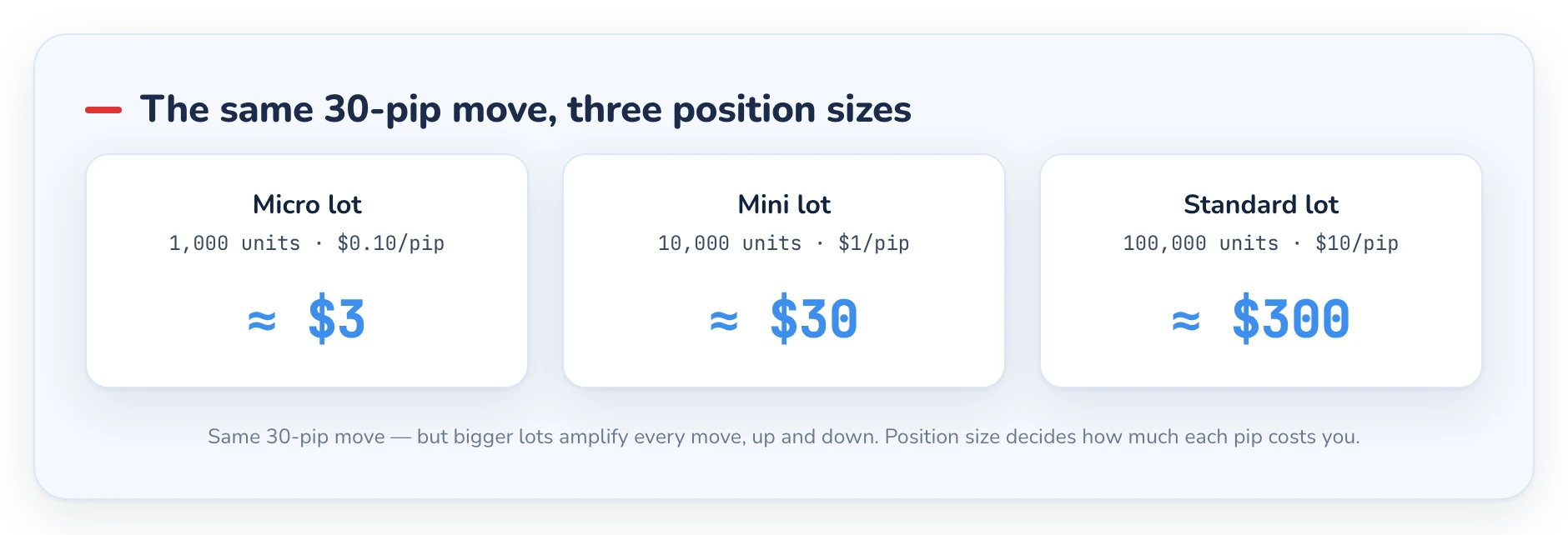
Lot size is what turns a pip move into real money. Here is what one pip is worth on EUR/USD at each size:
| Lot type | Units | Pip value (approx.) |
|---|---|---|
| Standard | 100,000 | $10 per pip |
| Mini | 10,000 | $1 per pip |
| Micro | 1,000 | $0.10 per pip |
Beginners should start with micro lots, where a 10-pip move is worth about $1 — enough to learn real emotions with almost no financial risk.
How a forex trade makes (or loses) money
Your profit or loss is simply pips moved × pip value. Buy one mini lot of EUR/USD ($1 per pip) and if the price rises 30 pips, you make about $30; if it falls 30 pips, you lose about $30. Scale up to a standard lot and that same 30-pip move is $300 either way. This is why position size matters more than being right — it decides how much each move costs you.
A worked first trade
Say you fund an account with $500 and cap risk at 1% — $5 per trade. You want to buy EUR/USD and set a stop-loss 20 pips away. To risk only $5 across 20 pips, you need a pip value of about $0.25, so you trade roughly 2.5 micro lots. You set a take-profit 40 pips out — a 2:1 reward. If the trade wins, you make about $10; if it loses, you are down $5. Trade this way and you can lose more often than you win and still grow the account, because your winners are twice your losers.
Forex Risk Management for Beginners
Forex risk management is the practice of limiting how much you can lose on each trade and across your account, using tools such as position sizing, stop-loss orders and cautious use of leverage. It does not remove risk or guarantee profits, but it helps beginners keep losses small enough to keep learning.
Key takeaways
- Risk a small, fixed share of your account on each trade. 1% is a common starting point.
- Set a stop loss before you enter, at a level where the trade idea is clearly wrong.
- Use only a fraction of the leverage available and keep free margin in the account.
- Check an economic calendar first, because major releases can move prices sharply.
Why does volatility matter for forex risk?
Volatility is how far and how fast a currency pair moves, and it sets how much a trade can gain or lose in a short time. It changes with the trading session, the pair and the news. A pair such as GBP/JPY can move far more in a day than EUR/CHF, so the same position size carries different risk on different pairs. Before trading, check a pair’s typical movement, for example its average daily range, and size the trade and the stop around that rather than around what you hope will happen.
How does leverage increase forex risk?
Leverage lets you control a position larger than your deposit, and it magnifies losses exactly as much as it magnifies gains. At 1:100 leverage, $1,000 of margin controls a $100,000 position, and a 1% move against you equals $1,000, the entire margin. Using only a fraction of the leverage available and keeping free margin in the account lowers the chance of a margin call or a forced stop out.
How much should a beginner risk per trade?
A common guideline for beginners is to risk no more than 1% of the account on each trade, which is the amount you lose if your stop loss is hit. Position size follows from that amount and from the distance to your stop loss.
Position size = amount at risk ÷ (stop distance in pips × pip value)
Example: with a $2,000 account, 1% is $20. If the stop loss is 25 pips away, $20 ÷ 25 = $0.80 per pip, which is about 8 micro lots ($0.10 per pip each). If the stop distance changes, the size changes with it and the amount at risk stays the same.
What is a stop loss and where should you place it?
A stop loss is an order that closes a trade automatically at a level you choose in advance, limiting the loss on that trade. Place it where the trade idea is clearly wrong, such as beyond a recent swing high or low, rather than at an arbitrary distance, and avoid moving it further away once the trade is open. In fast markets or around price gaps, a trade can close at a worse price than the stop level. This is called slippage.
What is a good risk-reward ratio?
Many traders look for a risk-reward ratio of at least 1:2, which means aiming to gain twice what they risk, but the right ratio depends on the strategy and the win rate. The ratio and the win rate work together. The table shows the share of trades you need to win to break even, before spreads and commissions, which raise these figures slightly.
| Risk-reward ratio | Example (risk / target) | Break-even win rate |
|---|---|---|
| 1:1 | 20 pips / 20 pips | 50% |
| 1:2 | 20 pips / 40 pips | 33.3% |
| 1:3 | 20 pips / 60 pips | 25% |
A higher ratio does not make a trade better if the target is unrealistic.
How do economic news and events affect forex risk?
Major releases such as central bank rate decisions, inflation data and employment reports can move prices sharply within seconds, and spreads often widen. Check an economic calendar before you trade. Beginners can reduce their position size, avoid opening new trades just before major releases, or wait until volatility settles.
Practical risk management tips for beginners
- Risk a small, fixed percentage of your account per trade.
- Set the stop loss before you enter the trade, not after.
- Watch your total open risk. Correlated pairs such as EUR/USD and GBP/USD often move together, so holding both can double your exposure.
- Keep a trading journal with your reason for entry, stop level and result, and review it regularly.
- Practise on a demo account before risking real money.
- Set a maximum daily or weekly loss, and stop trading when you reach it.
Risk warning: good risk management does not guarantee profits. Forex and CFD trading carries a high risk of loss, and you can lose more than expected in fast markets.
Common beginner mistakes to avoid
- Trading too big. Risking 10–20% on one trade turns a normal losing streak into a blown account. Cap risk at 1%.
- No stop-loss. Always decide your exit before you enter. Hoping a loser recovers is how small losses become huge ones.
- Over-leveraging. High leverage feels powerful until a small move wipes out your margin. Use it sparingly.
- Chasing the market. Jumping into trades out of boredom or revenge after a loss is a fast way to lose money.
- Skipping the demo. Real money is an expensive classroom for lessons a demo teaches for free.
How to start forex trading — step by step
- Learn the basics — pips, lots, leverage, and one simple strategy. Our forex trading strategies guide is a good start.
- Open a demo account and practice with virtual funds until your process feels routine.
- Choose a broker and platform. Tradeview Markets offers the MetaTrader and cTrader platforms, with the charts and order types you need.
- Fund a live account and start with micro lots. Open a live account and risk 1% or less per trade.
- Keep a trading journal and review it. Logging every trade is how you actually improve.
For the full cross-market roadmap, see how to start trading.
Frequently asked questions
How much money do I need to start forex trading?
You can start with as little as a small deposit if your broker offers micro lots. What matters more than the amount is risking only a tiny percentage per trade and only using money you can afford to lose.
Is forex trading hard for beginners?
The mechanics are simple; the discipline is hard. Most beginners lose at first because of poor risk control, not because forex is complicated. Start on a demo, trade tiny, and focus on managing risk.
How long does it take to learn forex trading?
Expect months of practice before consistency. Treat early results as tuition. Steady progress on a demo, then on micro lots, beats chasing a quick win.
What is the best forex pair for beginners?
EUR/USD — it is the most liquid pair, with tight spreads and abundant learning material, which makes it the easiest to trade while you learn.
Can I teach myself forex trading?
Yes. Most traders are self-taught using free resources, a demo account, and disciplined practice. Pick one pair and one strategy and go deep rather than spreading yourself thin.
Sources
Bank for International Settlements (2025). Triennial Central Bank Survey — OTC foreign exchange turnover in April 2025. Global FX turnover reached $9.6 trillion per day. bis.org
Barber, B. M., & Odean, T. (2000). Trading Is Hazardous to Your Wealth: The Common Stock Investment Performance of Individual Investors. The Journal of Finance, 55(2), 773–806. doi.org
Risk warning. Trading Forex and CFDs carries a high level of risk and may not be suitable for all investors. Leverage can work against you as well as for you. The examples are illustrative, not trading advice. This article is for educational purposes only and does not constitute financial advice. Only trade money you can afford to lose.