

A funded trading account lets you trade a proprietary trading firm’s capital instead of your own. You first pass the firm’s evaluation, or “challenge,” to prove you can trade within its rules. Once funded, you keep a share of the profits — often 70% to 90% — while the firm carries the risk.
That is the pitch, and it is genuinely appealing: skilled traders are usually short on capital, and firms are short on skilled traders. This guide explains how funded accounts and prop firms actually work, what the rules mean, why most people fail the challenge, and how to tell a legitimate firm from a scam before you pay a cent.
What is a funded trading account?
A funded trading account lets you trade money supplied by a prop firm (short for proprietary trading firm) rather than money from your own pocket. In exchange for that capital, you agree to trade within a strict rulebook: a profit target to hit, loss limits you cannot breach, and a set of conduct rules. You typically pay an upfront fee to attempt the evaluation. If you pass and stay inside the rules, you get to keep most of the profit; if you break a rule, the account is closed.
Two details matter from the start. First, most retail “funded” programs run on simulated (demo) accounts, at least through the evaluation and often beyond it. You are trading real market prices, but the firm decides when and whether to mirror your trades on a live venue. Second, the firm’s business model has two revenue streams: the profit split from genuinely good traders, and the challenge fees paid by everyone who tries. Understanding both keeps your expectations honest.
Funded account vs. prop firm vs. trading challenge — the words explained
These terms get used loosely, so here is the plain-English version:
| Term | What it means |
|---|---|
| Prop firm | The company that puts up the capital and sets the rules. |
| Funded account | The account you trade once you’ve passed the firm’s test. |
| Trading challenge / evaluation | The paid test you take to earn the funded account. |
| Profit split | The share of profits you keep (the firm keeps the rest). |
| Drawdown limit | The maximum you’re allowed to lose before the account is cut. |
How do prop firms and challenges work?
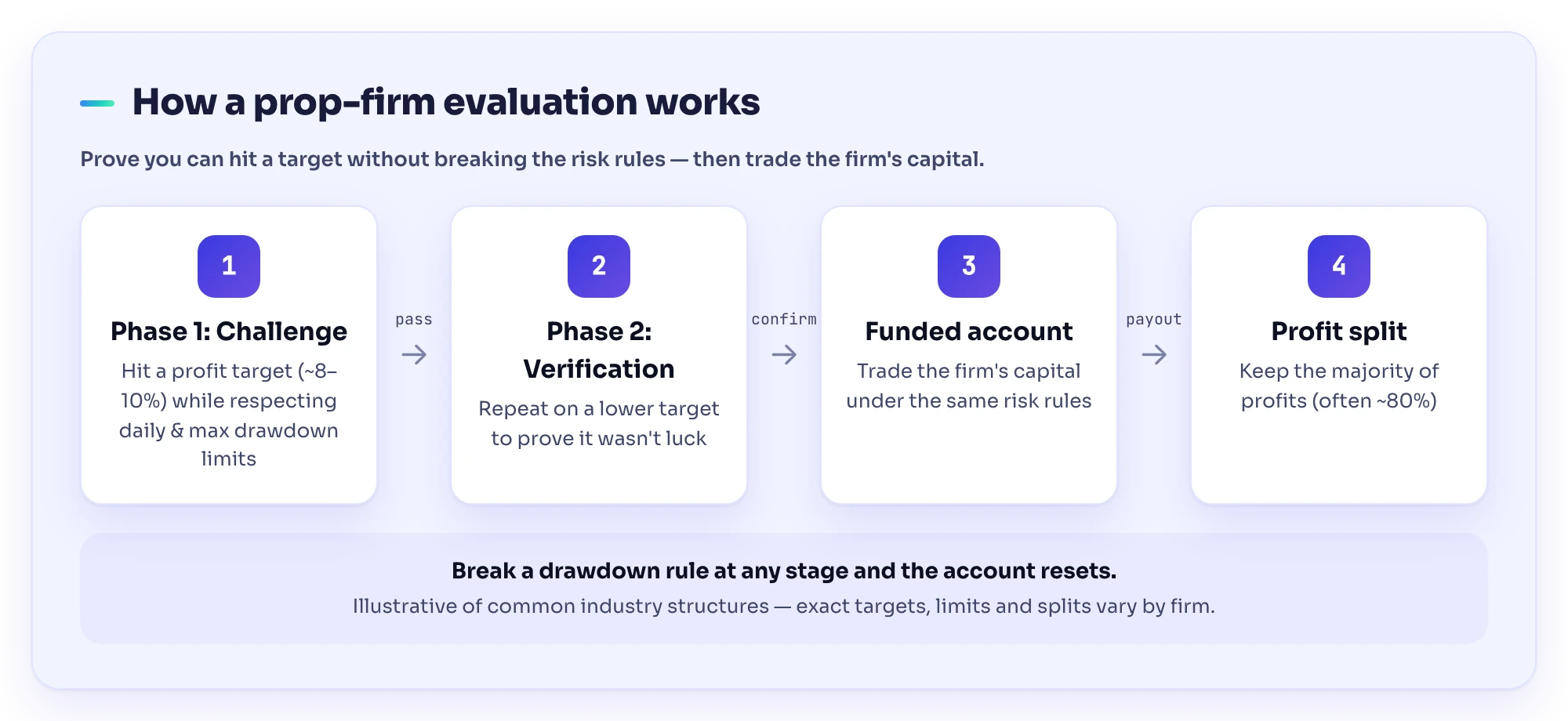
Getting funded is a process, not a purchase. Most firms run some version of these stages:
- Buy the evaluation. You choose an account size (often quoted as $10,000 to $200,000 of buying power) and pay a one-time fee, commonly $50 to $600 depending on size.
- Pass the challenge. You trade toward a profit target — frequently around 8% to 10% — without breaking any loss limits, over a minimum number of trading days.
- Pass verification (if two-step). Many firms add a second, easier phase with a smaller target to confirm the first result wasn’t luck. One-step and instant-funding models also exist.
- Get the funded account. You now trade the firm’s capital under ongoing rules and begin earning a profit split.
- Request payouts. After a minimum period, you can withdraw your share, usually on a fixed payout cycle.
The rules that actually matter
The rulebook is where accounts live and die. The ones to understand before you start:
- Profit target. The gain you must reach to pass a phase (e.g., 8% of account size).
- Maximum drawdown. The largest total loss allowed from your starting balance or peak — often 8% to 12%. Some firms use a trailing drawdown that rises with your equity, which is stricter than it sounds.
- Daily loss limit. A cap on how much you can lose in a single day, commonly 4% to 5%. This is the rule that ends most challenges.
- Minimum trading days. You usually can’t pass in one lucky session; firms require a handful of active days.
- Consistency rule. Some firms cap how much of your total profit can come from a single day or trade, to filter out one-off gambles.
- Restricted activity. Holding through major news, weekend gaps, or certain instruments may be banned. Read this list — breaking it can void an otherwise passing account.
Worked Example: The gap between your starting balance and your drawdown floor is smaller than beginners expect. On a $50,000 account with a 5% daily loss limit, your floor is a $2,500 loss. Two ordinary 2% losing trades — about $1,000 each — plus one emotional decision can end your trading day inside a single session.
(Illustrative — 5% of $50,000 = $2,500; figures are examples to show how tight the limits run, not any specific firm’s terms.)
The pros and cons of funded trading
Where funded accounts genuinely help:
- Access to capital. A skilled trader with a small savings balance can trade meaningful size without risking years of savings.
- Capped downside. Your financial risk is largely the challenge fee, not the full account. The firm absorbs trading losses on a funded account.
- Built-in discipline. The rules force position sizing and loss limits that most retail traders never impose on themselves.
- A clear target. Passing an evaluation is a concrete, measurable goal, which can sharpen an otherwise aimless practice routine.
Where they bite back:
- You pay to play, repeatedly. Fees add up fast across multiple attempts, and the average funded trader makes several.
- Simulated reality. Many accounts never touch a live market, so “funded” can mean a demo account with a payout attached.
- Rule complexity. Trailing drawdowns, consistency caps, and news restrictions catch traders who didn’t read carefully.
- Payout uncertainty. Passing is not getting paid — funded accounts can be lost before you ever withdraw, and payout terms are set by the firm.
- A regulatory gray zone. Most retail prop firms hold no financial-services license, so the usual investor protections may not apply (more on this below).
Be honest: most people fail the challenge
This is the part the marketing skips. Across the industry, the large majority of people who pay for a challenge never reach a funded payout.
The best independent data comes from FPFX Technology, a technology provider that works directly with prop firms. Its analysis of more than 300,000 accounts from around 100,000 traders across ten firms found that only about 14% passed a challenge, and just 7% of all traders ever reached a payout — reported by industry outlet Finance Magnates in September 2024. Firm-reported figures land in a similar range: published pass rates commonly sit between 5% and 10% per attempt, and one of the more transparent firms disclosed that only 16.8% of its evaluation accounts were completed successfully in 2025.
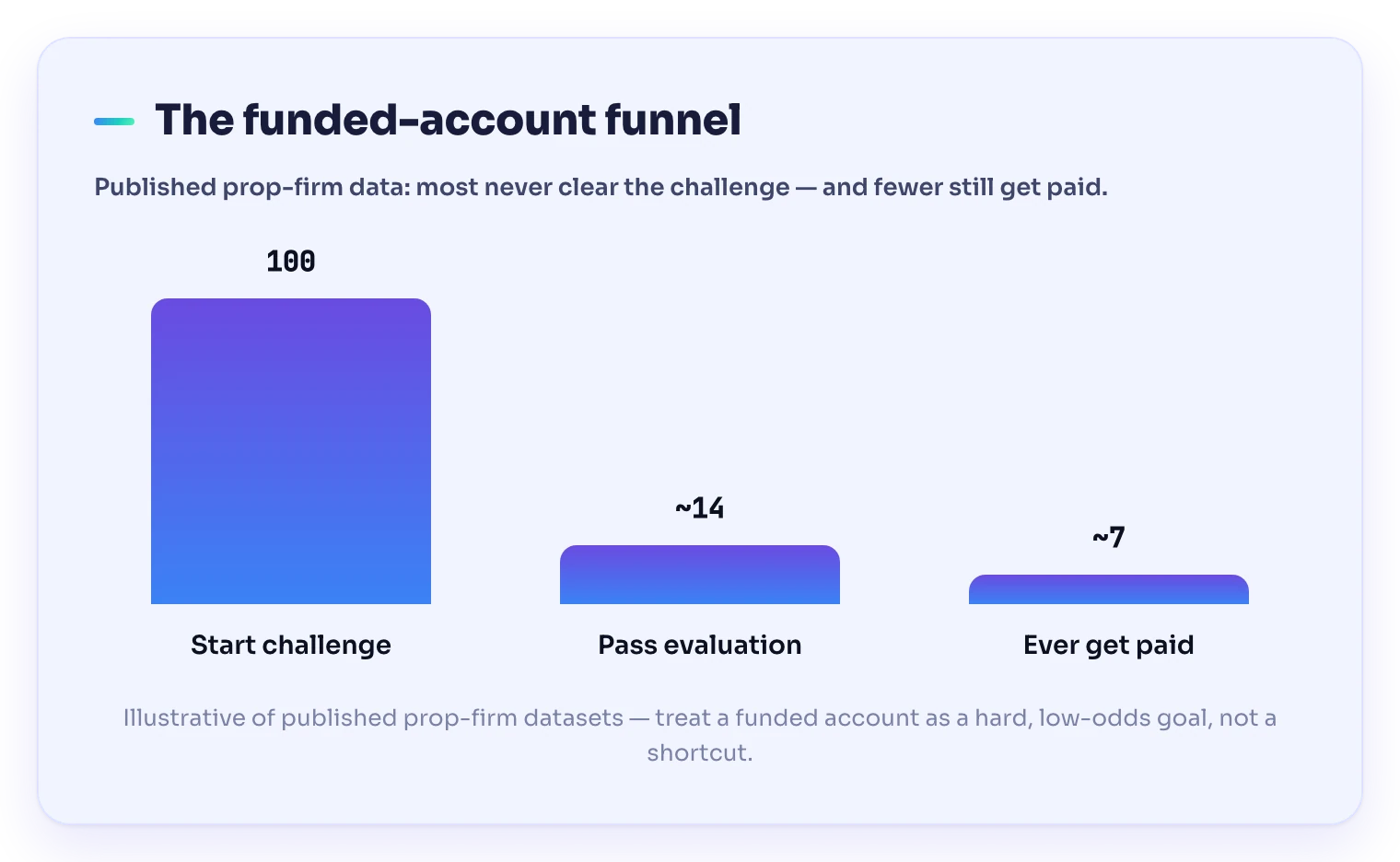
Watch for Traps: Read the shape, not the exact number: roughly 1 in 7 passes a challenge, and only about 1 in 14 ever withdraws real money. And most failures aren’t dramatic near-misses at the profit target — they cluster in the first week, on a daily loss limit breach, a behavioral failure rather than a strategy one. If you go in expecting to pass on the first try, the data says you are the exception, not the rule. Budget for more than one attempt — or better, don’t attempt one until your live results already respect the limits you’ll be tested on.
How to choose a legit firm — and spot the scams
Prop trading has attracted regulator attention precisely because some firms profit more from failed challenges than from funded traders. Belgium’s markets regulator, the FSMA, publicly warned consumers that prop firms let people trade “without having to use their own money,” that the challenges “are not easy, not cheap and often consumers have to take, and pay for, several of them,” and that “there is a good chance that some consumers never pass the courses. This is how prop trading firms earn money from them.” The FSMA also stressed that these firms typically hold no authorization and are not supervised, and that payout terms can be opaque and decided unilaterally by the firm.
That doesn’t make every prop firm a scam — but it tells you exactly what to check.
Red flags — walk away if you see these:
- Guaranteed or “risk-free” profit language. No legitimate firm promises profit. It’s illegal in most jurisdictions and a classic fraud tell.
- Opaque or shifting payout rules. If you can’t find clear, written terms on how and when you get paid, assume the worst.
- Rules engineered to make you fail. Trailing drawdowns hidden in fine print, retroactive rule changes, or “server-side” execution complaints across many users.
- No verifiable payout proof. Look for independent evidence of real traders being paid, not testimonials on the firm’s own page.
- High-pressure social-media marketing. Countdown timers, influencer hype, and “last chance” discounts aimed at getting your fee before you think.
- Vague company identity. No named entity, no jurisdiction, no way to contact a real business.
Green flags — signs of a firm worth your fee:
- Clear, complete rules published before you buy, including drawdown type and consistency rules.
- Transparent disclosure of whether accounts are simulated or live.
- A documented, consistent payout history and reasonable payout cycle.
- A real, named operating entity and responsive support.
- Reasonable, achievable targets rather than lottery-ticket difficulty.
Before you pay, search the firm’s name alongside “payout proof” and “review,” read the full rulebook, and confirm the terms match the marketing. A few hours of due diligence is cheaper than a wasted challenge fee.
The real test is discipline, not strategy
Checkpoint: Here’s the uncomfortable truth the pass-rate data points to: a funded account mostly tests your behavior, not your system. The narrow daily and overall loss limits punish the exact habits a normal account would quietly absorb — revenge trading after a loss, overtrading to hit the target fast, doubling down on a loser, and refusing to stop after a bad session.
The traders who get funded are rarely the ones with the flashiest edge. They size small, they take the loss when it’s a loss, and they walk away when the day is done. That’s a psychological skill, and it’s trainable — start with our guide to trading psychology and emotional discipline. It also rests on a real, tested method: knowing your setups, your risk per trade, and your exit before you enter. Learning to read reliable structures — a clean cup-and-handle breakout or a tested supply-and-demand zone, for instance — and grounding it in solid technical analysis gives your discipline something concrete to defend.
Level Up: You don’t need to buy a challenge to build any of this. The habits that pass an evaluation are the same ones that make you a better trader on your own capital, and you can build them for free. Practice on a demo, study deliberately, and grow your skills with a trading community or academy like TradeGATEHub — start with our free trading education resources or the TradeGATEHub Academy. Get the discipline right first; the funded account, if you still want one, gets far easier after that.
Frequently asked questions
What is a funded trading account in simple terms?
It’s an account where you trade a prop firm’s money instead of your own, after passing the firm’s test. You keep most of the profit you make and the firm covers the trading losses, within set limits. You usually pay a fee to take the evaluation.
How do you get a funded trading account?
You buy and pass a prop firm’s challenge: hit a profit target (often around 8–10%) without breaching the daily loss limit or maximum drawdown, over a minimum number of trading days. Some firms add a second verification phase before funding you.
Is a funded trading account real money?
Sometimes. Many retail funded accounts are simulated, meaning you trade real prices on a demo account and the firm decides whether to mirror your trades live. Payouts are real, but the account you trade may not be a live-market account — always check how the firm discloses this.
How much does a funded account cost?
The evaluation fee typically ranges from about $50 to $600 depending on account size. Because most traders need more than one attempt, plan for the total cost of several challenges, not just the single advertised fee.
Are prop firms and funded accounts a scam?
Not all of them, but the industry has real bad actors, and regulators like Belgium’s FSMA have warned that some firms profit mainly from failed challenges. Legitimate firms publish clear rules, disclose whether accounts are simulated, and have a verifiable record of paying traders. Do your due diligence before paying.
What percentage of traders pass a funded challenge?
Independent data suggests only about 14% pass a challenge and roughly 7% ever reach a payout; self-reported firm pass rates commonly sit between 5% and 10% per attempt. Most failures come from breaching loss limits early, not from missing the profit target.
Sources
- Financial Services and Markets Authority (FSMA), Belgium — The FSMA warns consumers against the shadow investment game (7 March 2024). Primary regulator warning describing the prop-firm challenge model, its costs, the “you never make actual trades” simulated nature, the lack of authorization, and opaque payouts. fsma.be
- FPFX Technology dataset, via Finance Magnates (September 2024) — analysis of 300,000+ prop accounts from ~100,000 traders across 10 firms: ~14% passed a challenge and ~7% of all traders ever reached a payout; average payout ~4% of account size (of the ~14% who passed, about 45% reached a payout). Widely cited industry benchmark for prop-firm pass and payout rates. financemagnates.com
Risk warning. Trading forex, CFDs, and other leveraged products carries a high level of risk and may not be suitable for all investors. Leverage can work against you as well as for you, and you can lose more than your initial outlay. Proprietary trading challenges involve upfront fees that are typically non-refundable and are lost if you do not pass. Past performance and published pass rates are not indicative of future results. This article is general education only and is not financial advice or a recommendation of any specific firm.